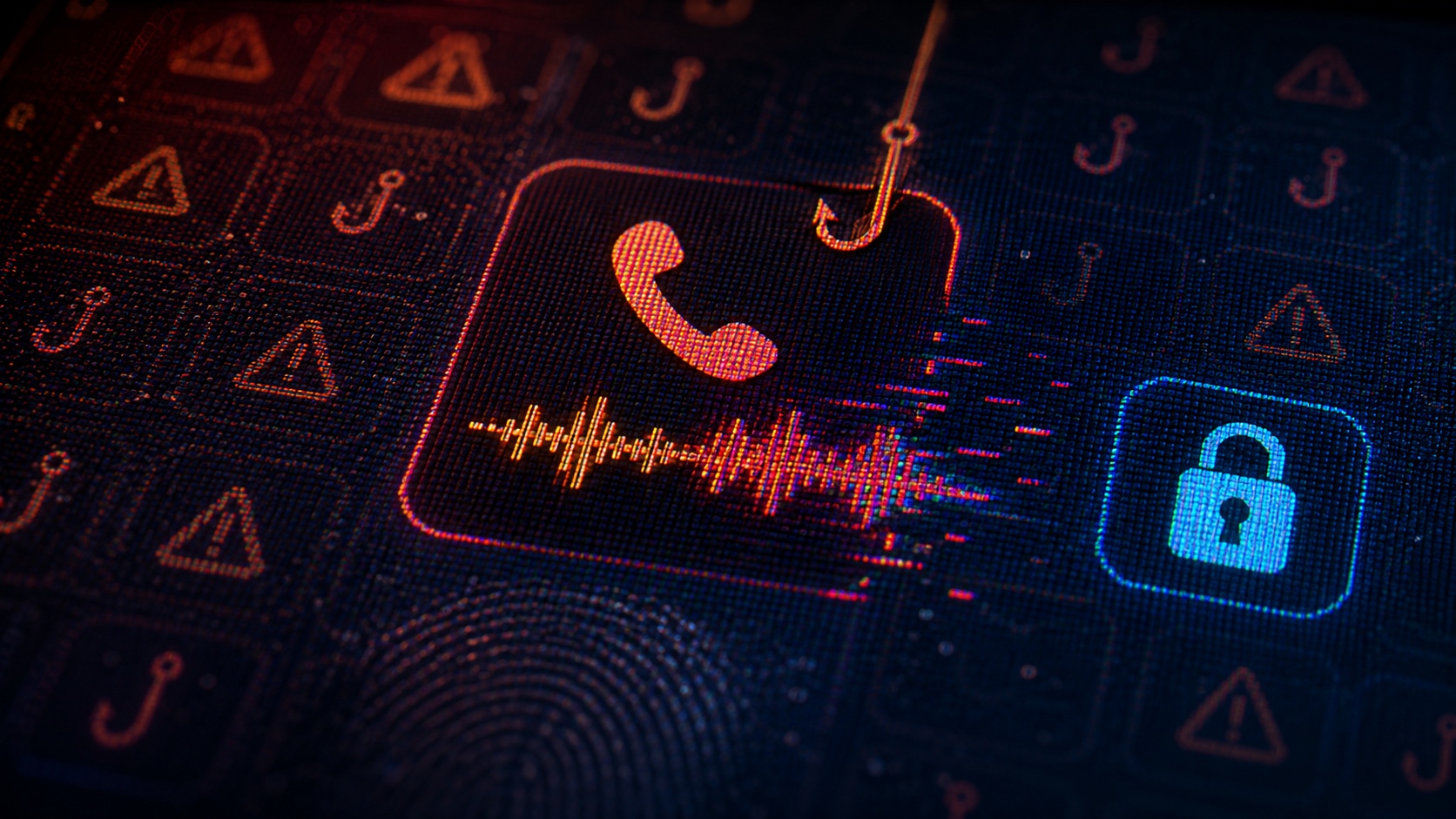
A familiar voice
Your phone rings, and it's her.
Your phone rings. It is your daughter. She sounds panicked. She says she is stuck in another city, lost her wallet, and needs money wired immediately. You hear her voice. You feel the familiar spike of fear. You are about to do exactly what the caller wants.
Except she is not calling. That voice is a copy. A digital echo stitched together from a few seconds of audio scraped from a social media video. The technology to build it costs nothing. The skill to use it is zero. And it is already in the hands of scammers worldwide.
What changed
Your old instincts will get you burned.
This is not a hypothetical scenario. It is the new baseline for digital fraud. Artificial intelligence has handed scammers powerful new tools, and ordinary people need to know the new tricks and how to defend against them. The game has changed. The rules of engagement have shifted. Your old instincts will get you burned.
In practice, this means treating every urgent request for money or sensitive data as a potential fabrication until you verify it through a separate channel. It means building simple, unglamorous habits that act as a firewall between you and a sophisticated attack. It means recognizing that the scammers are no longer relying on sloppy mistakes. They are relying on speed, scale, and your natural instinct to help.
Voice cloning
The voice that isn't your daughter.
Scammers no longer need hours of recordings or studio equipment. They use zero-shot voice cloning to replicate a target speaker using only seconds of reference audio. A casual video call, a public interview, a podcast clip, a voicemail left on a friend's phone. The model strips the speaker's vocal signature and rebuilds it on demand. The result is a synthetic voice that passes the ear test. You hear the familiar cadence, the familiar tone, the familiar panic. The scam relies on your amygdala hijacking your logic. The moment you feel that surge of urgency, the trap snaps shut.
What to look for is not a robotic tone. It is the demand for secrecy, the refusal to answer specific questions, the push for an unusual payment method, or a voice that sounds right but avoids giving you a callback number. If someone claims to be in a crisis and needs money now, hang up. Call them back on a number you already have. The real person will understand. The clone will not.
Phishing clones
Phishing got pixel-perfect.
For years, you could spot a phishing email by its typos, its awkward phrasing, or its suspicious sender address. AI erased those tells. Language models now draft flawless, context-aware messages in seconds. They scan public profiles, recent news, and professional networks to craft lures that feel personal. They generate clone phishing emails that mimic legitimate conversations so closely they bypass standard filters. They build fake login pages that look identical to your bank or email provider. You click a link in a polished message, land on a familiar interface, and type your credentials. The site captures them and forwards them to the attacker in real time.
What to look for is not a broken layout. It is the subtle wrongness in the URL, the request to act fast, the email that pushes you to click rather than work through to the site yourself. The trick is to never trust a link. Type the address yourself. Use a password manager to auto-fill credentials only on verified domains. If a page asks you to log in after you clicked a link, step back. Close the tab. Open a fresh window. Type the address. Verify.
Built for scale
Why it's everywhere at once.
Why is this happening everywhere at once? Because the tools are free, anonymous, and scalable. Commercial attack kits sit on open platforms, priced at a few hundred dollars, offering multi-factor authentication bypass capabilities to anyone with a credit card. The barrier to entry has collapsed. A single attacker can now run thousands of personalized lures across dozens of targets simultaneously. The math works in their favor. They only need one victim to wire funds or hand over credentials to make the campaign profitable.
This scalability has turned fraud into a volume game. The attacks are not targeted masterpieces anymore. They are automated factories. They flood inboxes and phone lines, counting on the statistical probability that someone, somewhere, will panic and comply. The financial impact is already massive, with billions lost globally as these campaigns operate around the clock without pause.
You cannot out-compute a machine. You can out-habit it.
— The defender's rule
Fighting back
You can't out-compute it. Out-habit it.
The most effective defense is not a new app or a complex security protocol. It is a set of small, deliberate habits you run every time, especially when the clock is ticking. When a message demands immediate action, you slow down. You treat urgency as a red flag, not a reason to rush. You verify through a channel you control. These are not paranoid measures. They are the digital equivalent of looking both ways before crossing the street. They take ten seconds. They save you from a lifetime of recovery.
Your firewall
Six habits that beat the playbook.
None of these require technical skill. They are routines. The scammers bank on your busy schedule and your desire to be helpful, betting you will skip the verification step when you feel rushed. Don't give them that advantage.
- A family safe wordDo this first
- Agree on a private word or phrase for emergencies. A cloned voice can fake panic. It cannot guess a word it never heard.
- Hang up and call backEvery time
- Never trust caller ID or a voice alone. End the call and dial the person back on a number you already have saved. The real person picks up. The clone is gone.
- Type addresses yourselfNever trust a link
- Don't click through from an email to log in. Open a fresh window and type the address by hand, so a pixel-perfect fake page never gets your credentials.
- Use a password manager
- It stops you reusing credentials across sites and refuses to auto-fill on a fake domain. The blocked auto-fill is itself a warning that the page is not what it claims.
- Turn on two-factor or passkeys
- A second layer that synthetic voices and cloned emails cannot bypass. Passkeys are the stronger option where they are offered.
- Treat urgency as a red flagThe tell
- Speed is the attacker's weapon. A real emergency survives a ten-second pause and a verification question. A scam does not. Slow down on purpose.
Ask a question only the real person would know. Check the URL character by character. The scammers rely on panic. You rely on routine.
Tech safeguards
Lock the basics.
Beyond habits, you need a basic technical floor. Turn on device-level security, update your software, and review your account recovery options regularly. Treat your digital identity like a physical home. Lock the doors. Check the windows. Don't leave the key under the mat. These tools do not make you invisible to attackers. They make you a hard target. They force the scammer to spend more time and money on you than they expect to gain. That is how you win. You raise the cost of the attack until it stops being worth their time.
There is a reason clone phishing works even when every system says the login is legitimate. It exploits the insider threat paradox. The credentials, the user identity, and the device recognition all appear valid while the human behind them is compromised by deception. Technical safeguards catch the digital trail. Your habits catch the human moment.
Honest limits
Nothing here is foolproof.
None of this is foolproof. Technology will always lag behind the tools it tries to police. Detection algorithms hunt for anomalies, but scammers constantly adapt their outputs to slip past the filters. Content provenance standards exist to verify media origins, but they raise real privacy questions about selective disclosure and who gets to decide what data travels with a file. Legal frameworks are catching up, but enforcement moves slower than code.
The honest limit is that no filter catches everything. No algorithm reads intent. No system can replace human judgment in the moment of pressure. The scammers know this. They design their attacks to exploit the gap between automated defense and human reaction. They count on the fact that you are tired, busy, and trying to be helpful. They do not need to beat your security software. They just need to beat your pause. Multimodal detection systems can flag inconsistencies in audio and video, but those systems require infrastructure you do not control. They cannot stop a scammer from calling you at 2 a.m. with a synthetic voice that sounds exactly like your spouse. The limit is structural. The defense must be personal.
Bottom line
The defense is yours to build.
The threat is real. The tools are accessible. The stakes are high. But the defense is entirely within your control. You do not need to become a cybersecurity expert. You need to become a little more skeptical, a little slower, and a little more deliberate. Agree on a safe word with your family. Hang up and call back. Type addresses yourself. Use a password manager. Turn on two-factor authentication. Slow down when someone pushes urgency. These simple habits defeat most of these tricks.
Just knowing what AI can do makes you harder to fool. Understand what's possible, and you'll spot the difference between real and fake before it costs you.
— Mandelson Fleurival
The scammers rely on panic. You rely on routine. Panic fades. Routine endures. Build yours. The next time your phone rings, let your habits answer before your heart does.
Share this post
Keep reading
More worth your time
Blog post · AI, Thoughts, Building
The Cloud Is a Liability
Every time a regulated firm pastes sensitive data into a cloud chatbot, it isn't using AI. It's leaking.
Read post →
Blog post · AI, Thoughts, Notes
How AI Actually Works, Term by Term
Thirteen words decode how AI really works, from token to scaling laws. No math degree required.
Read post →Stay in the loop
New posts, same voice.
Get a short email when I publish something new. No weekly digests, no link dumps — just the essays.